
Background
The balanced conversation cycle is a simple model that acts as a reminder that conversations are only effective when they are 2-way. While simple, and in some cases common sense in its approach, the cycle is a good reminder that when it comes to effective communication and effective conversations, both parties need an opportunity to speak and we can be the person that brings the other person into the conversation.
The Balanced Conversation Cycle
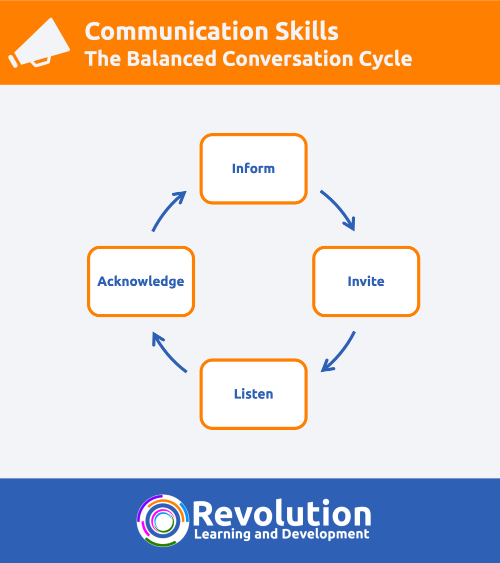
The balanced conversation cycle has 4 stages. These are:
Featured Course
Communication Skills
Enhance your ability to have balanced, two-way conversations that build rapport and understanding by exploring our Communication Skills Training Course.
- Inform
- Invite
- Listen
- Acknowledge
The 4 stages are laid out in a cycle or loop that shows how a conversation can be 2-ways and continuous, providing the cycle is followed.
Inform
The first stage of the balanced conversation cycle is inform. At this stage, we start the conversation or prompt the next stage of the conversation by providing (or telling the other party) some information. For example:
“Hello, my name is Jason.”
When we inform, the information we provide should be clear and conscience, useful and articulate.
Invite
The second stage of the balanced conversation cycle is invite. At this stage, we invite the other person into the conversation. We do this by asking effective questions.
So, following on from the first stage where we provided the person with our name, we could ask:
“What is your name?”

Listen
Now that we have asked a question, the third stage o the balanced conversation cycle comes into play. This stage is listen. We need to allow the other person to enter the conversation and, because we need to ensure we can complete the fourth stage, we need to listen effectively.
They may say:
“Hello Jason, my name is Jane”
Acknowledge
Not that we have heard some information from the other person, the fourth stage of the balanced conversation cycle starts and this stage is acknowledge.
Here, we need to show the other person that we have heard what they have said. We do this by acknowledging the information.
For example, we might say:
“It’s great to meet you, Jane”
We then follow the style around again and again. For example:
It’s my first time in this building (inform), have you been here before (invite)?. Yes, I was here last week (listen). Last week (acknowledge)? Great. Maybe you can help me (inform). Can you tell me where the boardroom is (invite)? Yes, it’s on the 3rd floor (listen). The 3rd floor (acknowledge). Thank you for your help, Jane, it was great to meet you.
Applying the Balanced Conversation Cycle
As previously mentioned, the balanced conversation cycle is very simplistic in its approach, but very worthwhile keeping in the back of your mind when communicating.
It can help us to build more effective relationships and ensure that people remember us in a positive light.
Further Learning
You can learn more about the balanced conversation cycle and other general communication skills tips by attending a communication Skills training course. Take a look at our Communication Skills Training Course for more details.
This article is © Revolution Learning and Development Ltd. Where the work is attributed to another person or entity, you will find this referenced in the article above and this person or entity carries the copyright.
You are welcome to use the information contained in this article for your own use and in your own work. The information in this article should not be re-published or sold without the express written permission of Revolution Learning and Development Ltd.
No single person authors our articles and posts and they are constantly updated, so we cannot provide an authors name or date of publication. For referencing, please quote Revolution Learning and Development Ltd and this website.