
Background
An empathy map is a tool that you can use to better understand your customers or colleagues. In fact, they can be used to better understand anyone. It allows you to put yourself in the shoes of the person the empathy map relates to so you can provide better, more meaningful responses. It also helps to build better relationships and deliver better customer service.
What is an Empathy Map?
Empathy maps were originally designed as part of customer journey mapping – mainly to build customer personas so that UX (user experience) designers could put themselves squarely in the position of a customer to understand how they may view service, an app, a website or any other aspect of service offered.
Featured Course
Customer Service Skills
Enhance your ability to understand and empathize with customers by mastering techniques like empathy mapping featured in our Customer Service Skills training course.
More recently, we have seen them used by those involved in the front line delivery of customer service as a way of understanding a customer’s current situation or position to allow much more meaningful responses.
An empathy map uses a 2 by 2 grid and asks us to consider the customers from 4 different positions or angles. There are other variations of this where more positions are considered, but in its simplest form, it’s 4 positions. This allows us to use the tool easily in most conversations.
An empathy map looks at 4 positions:
- What is the customer thinking
- What is the customer saying
- What is the customer doing
- What is the customer feeling
It’s these positions that give us a much better view and understanding of the customer and will allow us to deliver a higher level of service.
How to Create an Empathy Map
An empathy map is a 2 by 2 grid that has the 4 headings above in each of the boxes.
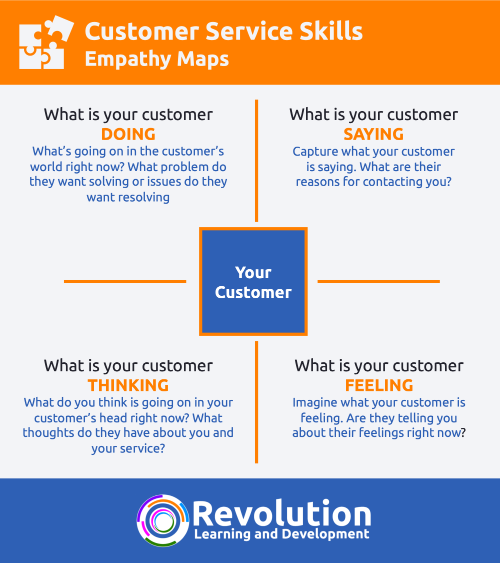
The first box in the empathy map asks what is the customer doing? Here we consider what's going on in the customer's world right now? What problem do they want solving or issues do they want resolving.
This allows us to get a good picture of their current situation and what their needs and wants will be.
The second box in the empathy map asks what the customer is saying. Here we capture what your customer is saying. What are their reasons for contacting you? This makes sure that we are listening to our customers and can formulate a more appropriate response.
The third box in the empathy map asks what we believe the customer is thinking. Here we consider what we think is going on in your customer's head right now? What thoughts do they have about you and your service? This helps us to put ourselves in their shoes and see more clearly where they are coming from.
The fourth box in the empathy map asks what the customer is feeling. Here we imagine what your customer is feeling. Are they telling you about their feelings right now? Added to the other 3 boxes, this now provides a full understanding of the customer and their situation and means we can provide a much more appropriate response.
How to Work in the 4 Boxes
Here is how to get what you need from each of the 4 boxes:
- What is the customer doing – use statements such as "if I understand correctly, this is what is going on...". This shows the customer that we have listened and also that we have understood their situation
- What is the customer saying – use your listening skills and paraphrase what you heard
- What is the customer thinking – state that you hear and understand their issue or problem and that you want to help put it right
- What is the customer feeling – using statements such as "I understand why this is making you angry"
Demonstrating Empathy
As you can see from the 4 points above, the empathy map will increase our ability to show empathy correctly. It helps us to see what we need to fully understand in order to be empathetic and therefore provide much more appropriate responses to customers
Further Learning
If you would like to learn more about empathy mapping and other customer service skills, take a look at our customer service training course where this and lots of other tips and ideas are covered.
This article is © Revolution Learning and Development Ltd. Where the work is attributed to another person or entity, you will find this referenced in the article above and this person or entity carries the copyright.
You are welcome to use the information contained in this article for your own use and in your own work. The information in this article should not be re-published or sold without the express written permission of Revolution Learning and Development Ltd.
No single person authors our articles and posts and they are constantly updated, so we cannot provide an authors name or date of publication. For referencing, please quote Revolution Learning and Development Ltd and this website.