
Background
The EDIC Training Method is a way of quickly and easily training someone else to conduct a task. It is mainly used for more process-oriented training and not soft-skills training.
It’s a 4 step process, where each step builds on the next to ensure the person being trained has a full understanding of the background of the tasks and also demonstrates their ability to do it, remember it and understand it.
Featured Course
Train the Trainer
Enhance your training skills and master the EDIC Training Method by attending our comprehensive Train the Trainer course, designed to help you train others effectively with proven techniques.
The EDIC Training Method
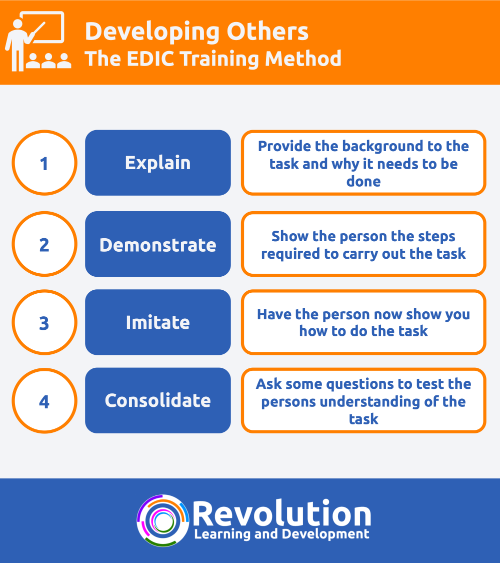
The EDIC Training method is a 4 step process. These 4 steps are:
- Explain
- Demonstrate
- Imitate
- Consolidate
Explain
The first stage of the EDIC Training Method is explain. In this first stage, we need to provide some context around the task. This should help the person you are training understand why the task is important, why it needs to be done, what are the consequences of not doing it correctly and when/how often it should be done.
Provide enough detailed information so that the person you are training can easily understand the context. Without this, the task may not seem that important the person being trained may begin to miss out on steps, make mistakes or not do the task at all.
Demonstrate
The second stage of the EDIC Training Method is demonstrate. Here, you should provide a full demonstration of how the task is carried out.
If it’s a complex task, you may want to repeat this step a few times, or break the task down into smaller component tasks and demonstrate one at a time.
When demonstrating, do this ‘by the book’. Don’t be tempted to throw in any shortcuts you may have picked up along the way. You need the person you are training to see and therefore understand the correct or best practice way of doing the task you are sowing them.
Imitate
The third stage of the EDIC Training Method is imitate. It’s at this stage that the person who is being trained should carry out the task based on what they saw.
You should carefully observe their approach and provide constructive feedback where needed.
It’s best to not keep interrupting the person being trained. You want to get a good sense of their overall understanding of the task. Stopping and starting can make this difficult.
Consolidate
The final stage of the EDIC Training Method is consolidate. Here, you will check the understanding of the person being trained.
To do this, you should ask a number of different questions about the task. These should be based on the background, the task itself and specific areas of the process.
You can also add in some scenario examples by asking ‘what if’ types of questions.
Should the person being trained to get any of the questions wrong, it will mean going back over that part of the process again to fill any gaps in their understanding.
Further Learning
To learn more about the EDIC Training Method, you may find it useful to attend a Train the Trainer Course. For more details about this type of course, see our Train the Trainer course.
This article is © Revolution Learning and Development Ltd. Where the work is attributed to another person or entity, you will find this referenced in the article above and this person or entity carries the copyright.
You are welcome to use the information contained in this article for your own use and in your own work. The information in this article should not be re-published or sold without the express written permission of Revolution Learning and Development Ltd.
No single person authors our articles and posts and they are constantly updated, so we cannot provide an authors name or date of publication. For referencing, please quote Revolution Learning and Development Ltd and this website.