
Delivering a Presentation
This post looks at How to Start a Presentation Effectively. If you have ever delivered a presentation before you’ll know it can be quite a daunting task. Something that often comes up in our presentation skills training course is that when we are asked to do a presentation, we can feel nervous, stressed and worried.
Nerves tend to get the better of us right at the beginning of the presentation. We ask ourselves ‘will they like it’ or ‘will they get it’ and self-doubt starts to creep in.
Featured Course
Presentation Skills
Boost your confidence and learn how to start and deliver presentations with impact in our Presentation Skills course, where you will master proven techniques like the INTRO acronym to engage any audience effectively.
Structuring the Start or Your Presentation
In our course, we talk about how to start a presentation and how having the start of your presentation mapped out correctly, and structured well will not only help you concentrate more on your actual presentation, but will help to quickly engage your audience.
Here are some things that you can do to effectively start your presentation and ensure that your presentation has impact.
How to Start a Presentation – The INTRO Acronym
The main thing to do is to use the INTRO acronym.
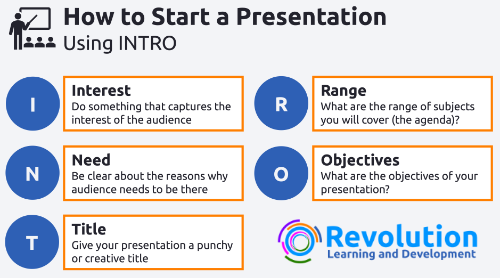
Interest – Think of something that you can do at the beginning of your presentation. You want something that captures the imagination of your audience – maybe tell a story or some appropriate humour. You want the audience to sit up and listen and engage with you before you even get to the main content.
Need – Why does your audience need to be there? What are the reasons why you have decided to do a presentation? One of the main reasons why people don’t engage well with presenters is that they don’t always clearly understand why they are there. Ensure you describe an issue or the reasons why people need the information you are about to give them.
Title – Give your presentation a catchy title. Sometimes avoiding the obvious can generate more interest. So for example ‘A Talk About Sales Figures’ won’t keep people guessing as to the content of your presentation, people may have already made up their mind whether they are going to listen to you.
Range – This is simply an agenda (agenda doesn’t fit into INTRO). Ensure that your presentation has a clear agenda or list of items you are going to cover.
Objectives – What are the objectives of the presentation. Help people to see what they will know, understand, be able to do etc. after they have received your information.
Using INTRO can help massively with the start of your presentation, reduce nerves and quickly engage people into your presentation.
Here’s an example of a ‘different’ presentation that uses INTRO. This is Ling Valentine, North East businesswoman and star of Dragon’s Den (note has a little bad language). Click here to see the video.
What do you think? What do you do to start your presentations?
Presentation Skills Training Course
If you would like more help with how to start a presentation, INTRO or any other aspect of delivering effective presentations, our presentation skills training course can help with all aspects of delivering presentations with impact.
This article is © Revolution Learning and Development Ltd. Where the work is attributed to another person or entity, you will find this referenced in the article above and this person or entity carries the copyright.
You are welcome to use the information contained in this article for your own use and in your own work. The information in this article should not be re-published or sold without the express written permission of Revolution Learning and Development Ltd.
No single person authors our articles and posts and they are constantly updated, so we cannot provide an authors name or date of publication. For referencing, please quote Revolution Learning and Development Ltd and this website.