
Hi, it’s David from revolution learning.
We run a lot of time management courses. People come to us for help with looking at ways to boost their productivity and efficiency and looking for ways to get more done in their day. People also ask us for help with reducing the sense of overwhelm that they feel with the amount they have to get done, or the feeling of stress or anxiety because of the number of things they’ve got on their To-Do List.
Featured Course
Managing Yourself and Personal Effectiveness
Boost your productivity and reduce overwhelm by mastering the 6 Time Management Principles with our Managing Yourself and Personal Effectiveness course, designed to help you plan, prioritise, schedule, organise, delegate, and maintain discipline effectively.
We’ve helped hundreds of people with these types of things! Our time management course is based on what we call our 6 Time Management Principles. These are six things that, if done well, will help you to be more productive more efficient and also begin to reduce those feelings of stress or overwhelm that you might be feeling.
Let’s take a look at what these six things are, what they mean and also how you could use them to increase your own levels of productivity and efficiency.
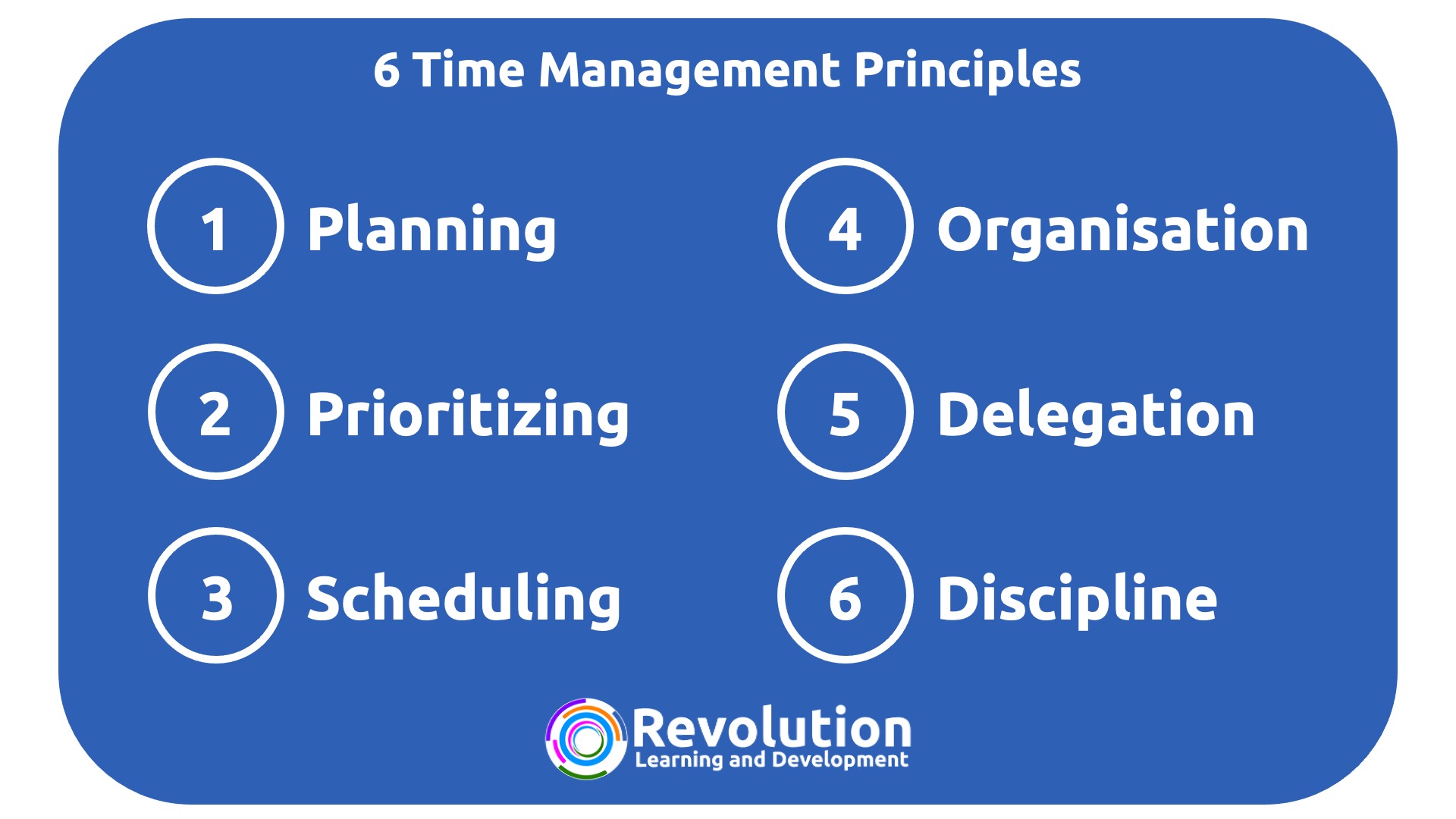
Principle one is known as planning. What we mean by planning is working out exactly what it is that you need to get done. This is you writing a to-do list for example. Or, if this was a project that you were working on, understand what are the individual tasks that you would need to complete in order to see that project through to completion. This is working out of the tasks that you need to get done.
Once that happens, those things need to be prioritised. What’s the order that you were going to do these tasks in. This is going to be based on importance – how important the task is and, potentially time as well – when is the deadline of when these things need to be completed.
Now we know what we need to do and we understand what order they need to come in. Once that’s been completed, our next principle is scheduling.
People think that scheduling and planning are the same things. Actually, they are two very different things. Planning is understanding what you need to get done where scheduling is committing the time to when you will do them. For example, you might block time out in your calendar or diary and commit that time to that task. We work out what we need to get done we work out the order that those things need to be done in, then we commit or block out the time that each of those individual tasks will be completed.
After we have planned, prioritised the schedule, we then need to organise – beginning to understand what tools and resources you need in order to make sure you can see your plan, or your schedule through to its completion. What technology do I need, what programmes do I need, what people do I need, what support do I need, what help and advice do I need, what decisions do I need to be made by other people. We need to understand how other things and other people can impact our ability to get things done. We should begin to think about all of these things at the beginning before we begin to run into problems later on in our list or into our project.
Once that’s been completed, we can then begin to think about what tasks we can delegate out. If you think that you can’t get everything done by yourself, or you need that external expertise or help, then you are going to need to pass some of your tasks onto somebody else. This is where delegation comes in – the art of transferring the responsibility from you to somebody else to complete those tasks. Delegation is a skill or art in itself.
We’ve planned, prioritised, scheduled and organised, we now know who we need to delegate to.
The last principle is discipline. When I talk about discipline, what I mean here is sticking with it. A lot of people that attend our time management training courses have a system, or they’ve tried something in the past, or they have a half-hearted attempt at something.
But, the reason a lot of people fail when it comes to time management is that they are not disciplined enough with sticking to their system or sticking to the approaches that they use to manage their time.
They say things like ‘yeah, I sometimes make a list’ or ‘I might sometimes put a plan together’ or ‘I put a plan together but it never gets completed because things change’. It’s discipline or the behavioural elements of time management that are so important to its overall success. You can have the best tools in the world to manage your time, but if you are not disciplined in using them, they’re not going to work.
You could use these six things in your everyday work to help with your time management. If you would like to find out more about how to be more productive, then check out our time management course where we of course cover these principles in much more detail.
I hope you find that useful and I look forward to seeing you next time.
This article is © Revolution Learning and Development Ltd. Where the work is attributed to another person or entity, you will find this referenced in the article above and this person or entity carries the copyright.
You are welcome to use the information contained in this article for your own use and in your own work. The information in this article should not be re-published or sold without the express written permission of Revolution Learning and Development Ltd.
No single person authors our articles and posts and they are constantly updated, so we cannot provide an authors name or date of publication. For referencing, please quote Revolution Learning and Development Ltd and this website.