
Communication Skills
This post looks at the 7 Cs of Communication. We communicate with people every day, both at work and in our personal life. We communicate using a number of different methods – face to face, telephone, email, instant messenger. letter, reports, meetings, presentations and more.
In order to ensure you get the right result when you communicate you need to ensure that your communication is effective and clear and this is where the 7 Cs of Communication can help.
Featured Course
Communication Skills
Enhance your communication effectiveness by mastering the 7 Cs of Communication with our dedicated Communication Skills Training Course.
The 7 Cs of Communication
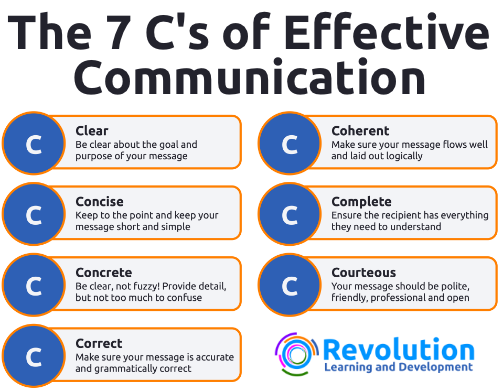
The 7 Cs is a checklist for ensuring your emails, meetings, calls, reports, presentations and other methods you use to communicate are clear and ensures the recipient gets the message.
- Clear
- Concise
- Concrete
- Correct
- Coherent
- Complete
- Courteous
Here’s what they mean:
- Clear – (Clarity) Be clear about the goal of your message and the purpose of the message. Present one idea at a time making it easier for the recipient to understand. Don’t leave them guessing what the message is about and having to fill in the gaps themselves.
- Concise – (Conciseness) Keep to the point and keep it short and simple. Don’t use unnecessary words (use two words where one will do or 6 sentences when 3 will do). Don’t repeat the same point in different ways.
- Concrete – (Concreteness) Be clear, not fuzzy. Make sure there is enough detail to get the message across but not too much that the recipient will be lost and ensure the message is factual.
- Correct – (Correctness) Check the information you are providing is accurate and in written communication ensure it is free from grammatical and spelling errors. Check the technical parts of your content are understandable by the person receiving the information.
- Coherent – Make sure your message flows well and is laid out logically. The points you make should all be linked to the main topic and should help you to deliver the objective you originally set out to achieve. Make sure the tone of the message is the same throughout.
- Complete – (Completeness) Ensure the recipient has everything they need to understand your message and take action if needed. If action is needed, ensure your message includes a ‘call to action’. Also, ensure that any specific details are clear and included. Don’t leave the recipient with lots of questions to ask.
- Courteous – (Courtesy) Your message should be polite, friendly, professional, open and honest. Think about your message from the recipient’s point of view and you are empathetic towards their needs. This will help you to deliver the message in a way that’s easy to understand and buy into.
By following the 7 Cs of communication you should find the messages you are delivering much more effective.
Communication Skills Training Courses
You can find out more about the 7 Cs of Communication and effective communication in general by attending our Communication Skills Training Course or for written communication our Business Writing Skills Training Course. See the Communication Skills training course overview here and the Business Writing Skills training course overview here.
This article is © Revolution Learning and Development Ltd. Where the work is attributed to another person or entity, you will find this referenced in the article above and this person or entity carries the copyright.
You are welcome to use the information contained in this article for your own use and in your own work. The information in this article should not be re-published or sold without the express written permission of Revolution Learning and Development Ltd.
No single person authors our articles and posts and they are constantly updated, so we cannot provide an authors name or date of publication. For referencing, please quote Revolution Learning and Development Ltd and this website.