
Background
When we deliver a time management training course, we want to give delegates a set of time management tools that they can use to increase their productivity. We want these tools to be easy to use and highly effective.
There are 100s if not 1000s of different time management tools that people have made available. Some are new and some variations of existing tools that have been around for many years.
Featured Course
Managing Yourself and Personal Effectiveness
Boost your productivity and effectiveness by mastering essential time management tools and techniques in our Managing Yourself and Personal Effectiveness training course.
Here are some of the time management tools that we recommend you look at to boost your levels of productivity.
Time Management Tools
As we said in the background above, there are a lot of time management tools out there. Here are some simple to use time management tools:
- To-do list
- Time Schedule
- Action Priority Matrix
- Urgent/Important Matrix
- Interruptions Log
- Pomodoro Technique
- Task Breakdown
To-do Lists
To-do lists are one of the most commonly used time management tools out there. Most people use some form of a to-do list, whether this is a list written in a book or added to an app such as Todoist or Outlook.
The idea of a to-do list is to get everything that you need out of your head and captured somewhere. This gives you a great oversight of everything that you need to get done.
The benefit of using a to-do list means that you shouldn’t forget anything (providing of course you remember to write it on your list).
To-do lists do have some downsides. Chief amongst them is that a to-do list is just a list of tasks. Unless you add some additional detail to the list such as deadline and priority, the list just becomes a list of things written on a sheet of paper that doesn’t necessarily drive any kind of action.
This leads us to the second downside. To-do lists can lead to overwhelm. When the list is large, we can become guilty of just staring at it and wondering where we should start. This means the list creates inaction rather than action.
When you create a to-do list, ensure you add in priority and some way of keeping an eye on deadlines. We also highly recommend that you create daily lists over one big list that include all of your tasks.
Time Schedule
If a to-do list is a plan, then we need to create a schedule. Creating a time schedule is a highly effective time management tool that will help you to get more done.
Scheduling your time simply means allocating time for every task that you need to complete. In essence, it’s blocking time out in a calendar or planner.
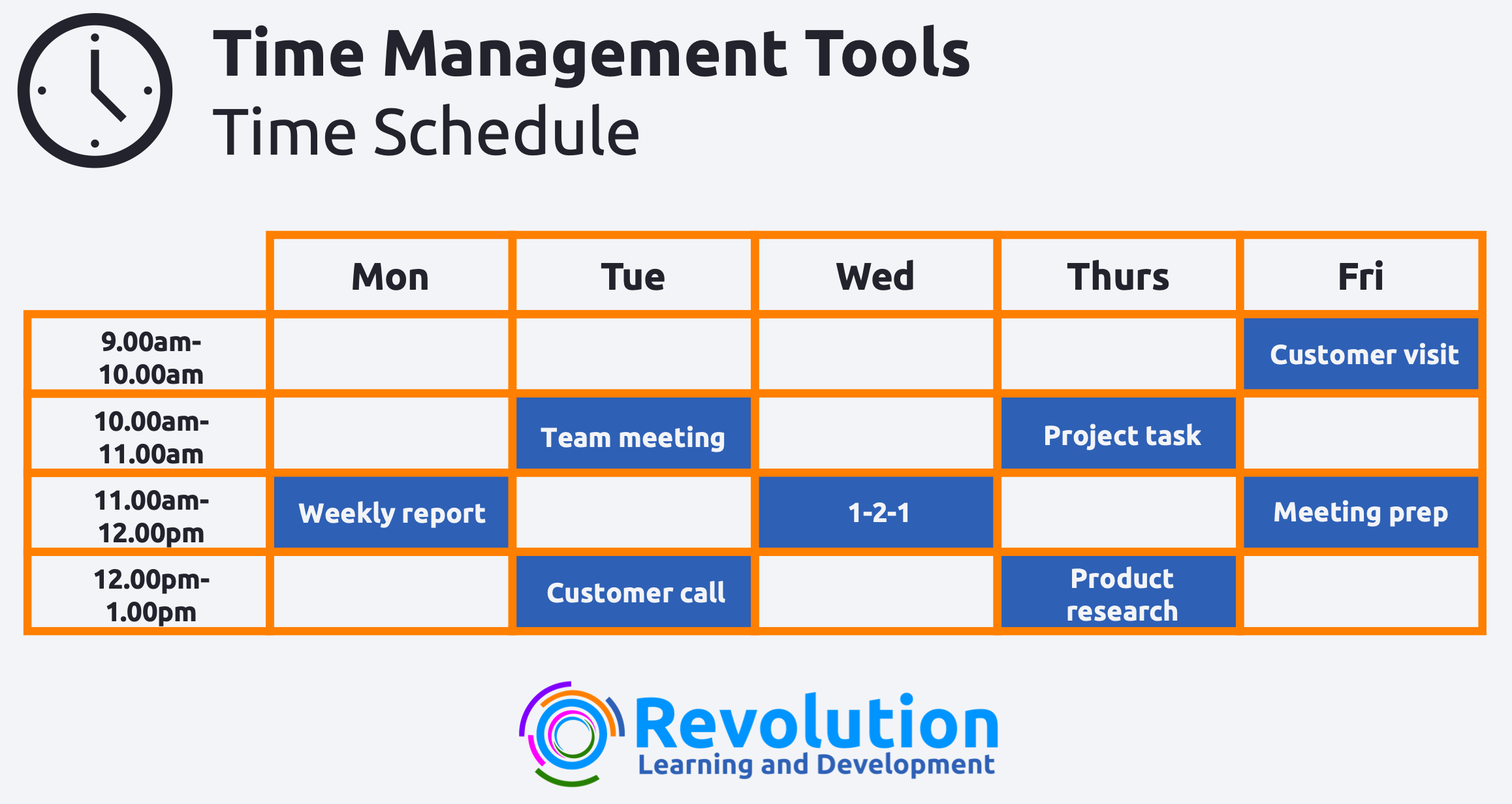
The downside of using a time schedule is setting it up. It can take some time, but once done, it’s just a matter of keeping it updated.
To learn more about planning and scheduling, take a look at the How to Schedule Your Time Effectively Article.
Action/Priority Matrix
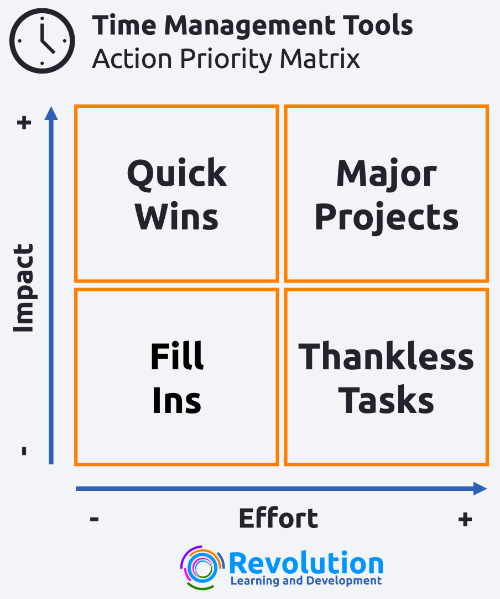
The Action/Priority Matrix is a simple to use time management tool that will help with prioritising your tasks. Rather than using the deadline as the driver behind the priority, it uses impact and energy.
For example, it helps you to identify what tasks take the smallest amount of energy to complete but deliver the biggest impact. These are known as quick wins. It then goes through to tasks that take a lot of effort with smaller returns. These are known as major projects.
The Urgent/Important Matrix
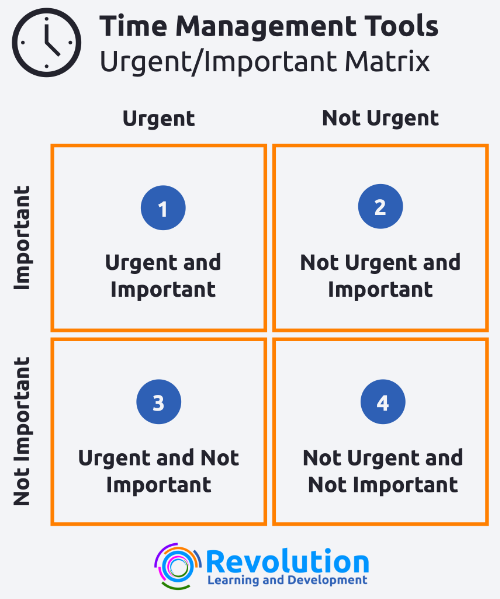
The Urgent/Important Matrix is probably one of the most common time management tools introduced in time management training and is widely used by many people. It’s a tool used for prioritising tasks.
The original name of this model is the Eisenhower Matrix as it was originally developed by President Eisenhower. It is now more commonly known as the urgent/important matrix. It takes this name as it uses 2 criteria time (urgency) and importance, and turns these into a 4 box grid.
The 4 boxes from the Urgent/Important matrix are:
- Urgent and Important
- Not Urgent and Important
- Urgent and Not Important
- Not Urgent and Not Important
Interruptions Log
The next of our time management tools is an interruptions log. This simple tool suggests that you spend some time, maybe a week, capturing each time you get interrupted and then analysing the data. This helps you to understand where your time goes and potentially who is stealing it.
You can see more details about using an interruptions log by reading our post Dealing With Interruptions – Start an Interruptions Log.
The Pomodoro Technique
The Pomodoro technique is one of our form favourites in our list of time management tools. The tool encourages the use of more regular breaks and breaking your day up into smaller chunks. The tool has been around for many years and is making a real resurgence in today’s busy world.
You can learn more about the Pomodoro technique by taking a look at our post The Pomodoro Technique.
Task Breakdown
The last of our time management tools is task breakdown. This tool suggests that we take the larger tasks that we need to complete and break them down into smaller tasks. The benefits of doing this are huge.
When we have a large task on our list of things to do, many of us will procrastinate. We do the easier tasks over the harder ones and the bigger task keeps getting pushed. Then, when we get into the right head-space to complete the big task, the risk is we get another that is more urgent and more important.
Breaking the bigger tasks into smaller more manageable tasks means they look less overwhelming. We can do one at a time and even spread these out over the course of a day or a week.
The big benefit is, once we get the first task done, we are much more likely to get the second, and then the third done.
When it comes to big tasks, the hard part isn’t getting them finished, it’s getting them started. Making the first task look easy means you are much more likely to keep going.
Time Management Training Course
To find out more about all of these time management tools, take a look at our time management training course. We’ve got them schedules all across the UK. You can learn more about our Time Management Training Course here.
This article is © Revolution Learning and Development Ltd. Where the work is attributed to another person or entity, you will find this referenced in the article above and this person or entity carries the copyright.
You are welcome to use the information contained in this article for your own use and in your own work. The information in this article should not be re-published or sold without the express written permission of Revolution Learning and Development Ltd.
No single person authors our articles and posts and they are constantly updated, so we cannot provide an authors name or date of publication. For referencing, please quote Revolution Learning and Development Ltd and this website.