
What is Plan-Do-Check-Act About?
Plan-Do-Check-Act (PDCA) is a step by step process management method used for the continuous improvement of products and processes.
Also known as the Deming Cycle or the Shewhart Cycle, Plan-Do-Check-Act is a four-step process that helps review current processes and identify improvements that can be made. Although the cycle won’t do these things alone, it works as a check that new ideas you are about to implement work the first time. It’s a process to follow when you need to make a change.
Featured Course
Critical Thinking and Problem Solving Training Course
Enhance your problem-solving skills and learn how to apply the Plan-Do-Check-Act cycle effectively with our Critical Thinking and Problem Solving Training Course.
Developed by W Edwards Deming who believed having clearly defined, repeatable processes in areas such as quality management and process control used this approach.
The cycle can be used in many areas such as implementing continuous improvement, improvements to processes in the business, a controlled approach to finding the best of a range of solutions to implement, saving time during change and many other areas.
The Four Stages of Plan-Do-Check-Act
As the name suggests, Plan-Do-Check-Act comes with 4 stages, named after its title. The model represents a cycle that suggests Plan-Do-Check-Act is a continuous process.
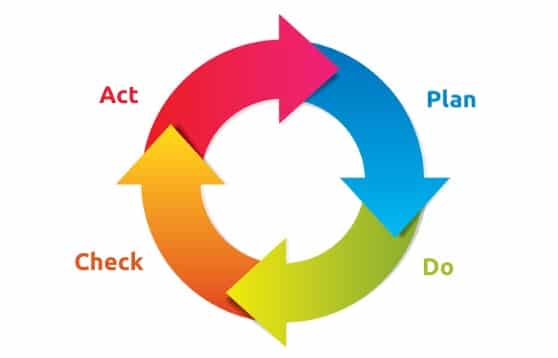
The Plan Stage
Identifying and analysing the problem. Here you need to identify exactly what the problem is. You can use a range of problem-solving tools like cause and effect diagrams (Ishikawa Diagram) or drill down to get from big chunks of information to more detailed information.
Set objectives that you now want to achieve and map the process that is causing the problem. You can learn more about Process Mapping on our Process Mapping Training Course.
The Do Stage
This is where you will begin to consider the things that you can do to solve the issue. You could brainstorm a range of solutions that could fix the problem then go through a process of reviewing each one until you agree on the best solution. Tools such as impact analysis, brainstorming, Hurson’s Productive Thinking Model and Appreciative Inquiry can work well here.
Once you have agreed on the solution, think about running a test on a controlled group to ensure your solution will deliver the results you require before rolling it out to the wider group.
The Check Stage
This is where you will measure the results of the test you conducted to ensure it will meet the objectives you set in stage one. You can also repeat the Do and Check stages, making small tweaks and changes to test if different variations of the solution will deliver better results. Once you are happy that the objectives can be delivered you can then move on.
The Act Stage
Once you know that your solution can deliver the objectives you can begin to roll it out on a larger scale to the wider group. This should be carefully planned. After roll-out, you may want to repeat the cycle to look for further improvements that can be made.
Plan-Do-Check-Act Training Course
If you would like to know more about Plan-Do-Check-Act and how to use it in your day to day work, our Critical Thinking and Problem Solving Training Course will provide you with some help and guidance on this.
This article is © Revolution Learning and Development Ltd. Where the work is attributed to another person or entity, you will find this referenced in the article above and this person or entity carries the copyright.
You are welcome to use the information contained in this article for your own use and in your own work. The information in this article should not be re-published or sold without the express written permission of Revolution Learning and Development Ltd.
No single person authors our articles and posts and they are constantly updated, so we cannot provide an authors name or date of publication. For referencing, please quote Revolution Learning and Development Ltd and this website.