
Background
In our time management training course, we look at a tool called the Pomodoro Technique. This is a really simple tool that boosts productivity and has a positive impact on well-being.
If you find that your productivity varies from day to day. Some days you get lots done and others you struggle to get through all of your tasks then this little technique can help.
Featured Course
Managing Yourself and Personal Effectiveness
Boost your productivity and wellbeing by mastering the Pomodoro Technique and other time management strategies in our Managing Yourself and Personal Effectiveness course.
We often think that long hours and days packed full of tasks leads to higher productivity, but research from the University of Illinois in 2008 suggests otherwise. The study shows that being stuck at your desk and ploughing through tasks actually makes you less productive. Not only that it can also have an adverse impact on your health.
Taking regular short breaks though actually increases productivity.
The Pomodoro Technique
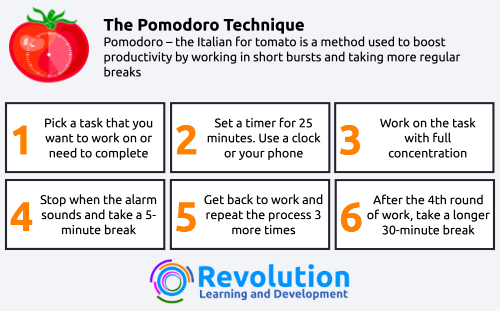
The Pomodoro Technique developed by Francesco Cirillo in the 1980s and shown in his book ‘The Pomodoro Technique‘ suggests that you break your tasks down into 25-minute sessions known as ‘A Pomodoro‘. Each session is then followed by a short break.
The name Pomodoro was taken from the tomato-shaped kitchen timer that Cirillo used to manage his time at University.
As we mentioned before, the technique suggests you break your tasks down into 25-minute sessions, then take a quick 5-minute break after each before starting on your next task. After completing 4 tasks like this, take a longer break (such as your scheduled break or lunch) to fully rest.
This might seem counter-productive, but the research suggests that this approach means you are much more focused and therefore productive.
Pomodoro Technique Tips
Here are some tips to help with this tool:
- Break up your tasks – take a look at your task list and break the tasks down into 25-minute sessions. You may want to experiment with times but 25 minutes is the recommendation.
- Use a Timer – Set some form of timer to ensure you stick to your allocated time
- Take Breaks – Be disciplined and take the breaks between tasks
- Work on one task – When you break your tasks down, only work on one task in your allocated time
Time Management Training Course
To find out more about using this and other time management techniques, take a look at our time management training course. We’ve got them schedules all across the UK. You can learn more about our Time Management Training Courses here.
This article is © Revolution Learning and Development Ltd. Where the work is attributed to another person or entity, you will find this referenced in the article above and this person or entity carries the copyright.
You are welcome to use the information contained in this article for your own use and in your own work. The information in this article should not be re-published or sold without the express written permission of Revolution Learning and Development Ltd.
No single person authors our articles and posts and they are constantly updated, so we cannot provide an authors name or date of publication. For referencing, please quote Revolution Learning and Development Ltd and this website.