
[toc]
Stakeholder Management
Whether you are working on a project, leading a team or trying to get a new idea past the board you will need to work with stakeholders.
Featured Course
Negotiation and Influencing Skills
Boost your stakeholder management and influencing success with our practical Negotiation and Influencing Skills training course, designed to help you build strong relationships and win agreement for your ideas.
Stakeholder management is a key skill of the modern-day manager and is used to get people on board with your ideas.
Knowing who to get on board, who to approach and who to invest your energy in building strong relationships is where Stakeholder Analysis becomes useful.
Stakeholder Analysis
Working with the right people means you can use their opinions and input to gain agreement from others. It can help you to get more resources for your project and other ideas.
Staying in touch with your stakeholders maintains relationships to ensure you get the support that you need for your ideas. You can gather feedback, tips and ideas from others making it easier to influence them.
To conduct a stakeholder analysis you will first need to understand who your stakeholders are. Once you have done that you can start to work out who the most important stakeholders are.
Think of internal and external people. Write them in a list. Capture their name and job titles. You might also want to think about links between them i.e. do they know each other and if so how.
Then prioritise them. To do this you can use a tool called The Power/Interest Grid.
The Power/Interest Grid
Here’s what it looks like:
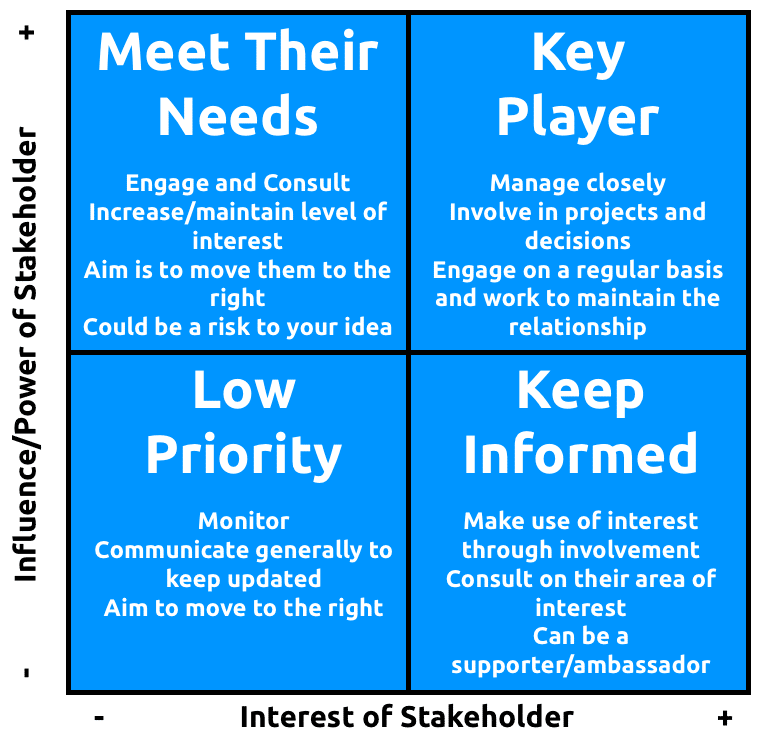
The grid uses 2 axis – Power and Interest:
- Power – How much influence do they have over your project/idea. Can they help to move it forward or could they stop it in its tracks?
- Interest – How much interest do they have in your project/idea? Will it be beneficial to them for example?
- High Power/High Interest – You will need to fully engage with these people and make a great effort to satisfy them. Keep the relationship you have with them strong
- High Power/Low Interest – Work here to keep these people satisfied, but not too much though – you don’t want them to become fed up with your message
- Low Power/High Interest – Keep these people updated and in the loop. Talk to them about what’s going on in the business etc.
- Low Power/Low Interest – Keep an eye on these people, but don’t annoy them with lots of unnecessary communication.
You will need to think about your stakeholders and learn about them.
Think about how your work, idea or project will benefit them, what is important to them, what will they want to know and not want to know, how well do they currently know you (do you have credibility), what will they worry about, who else are they connected to.
Find out as much as you can as this will help with a strategy to build better relationships with them.
Relationships are the first steps in good influencing, but knowing who to invest time and energy in building good relationships with is the first part of that.
Training Courses About The Power/Interest Grid and Stakeholder Management
Want to know more? Check out our workshops and courses that can help with Influencing, Commercial Awareness and Communication Skills.
This article is © Revolution Learning and Development Ltd. Where the work is attributed to another person or entity, you will find this referenced in the article above and this person or entity carries the copyright.
You are welcome to use the information contained in this article for your own use and in your own work. The information in this article should not be re-published or sold without the express written permission of Revolution Learning and Development Ltd.
No single person authors our articles and posts and they are constantly updated, so we cannot provide an authors name or date of publication. For referencing, please quote Revolution Learning and Development Ltd and this website.