
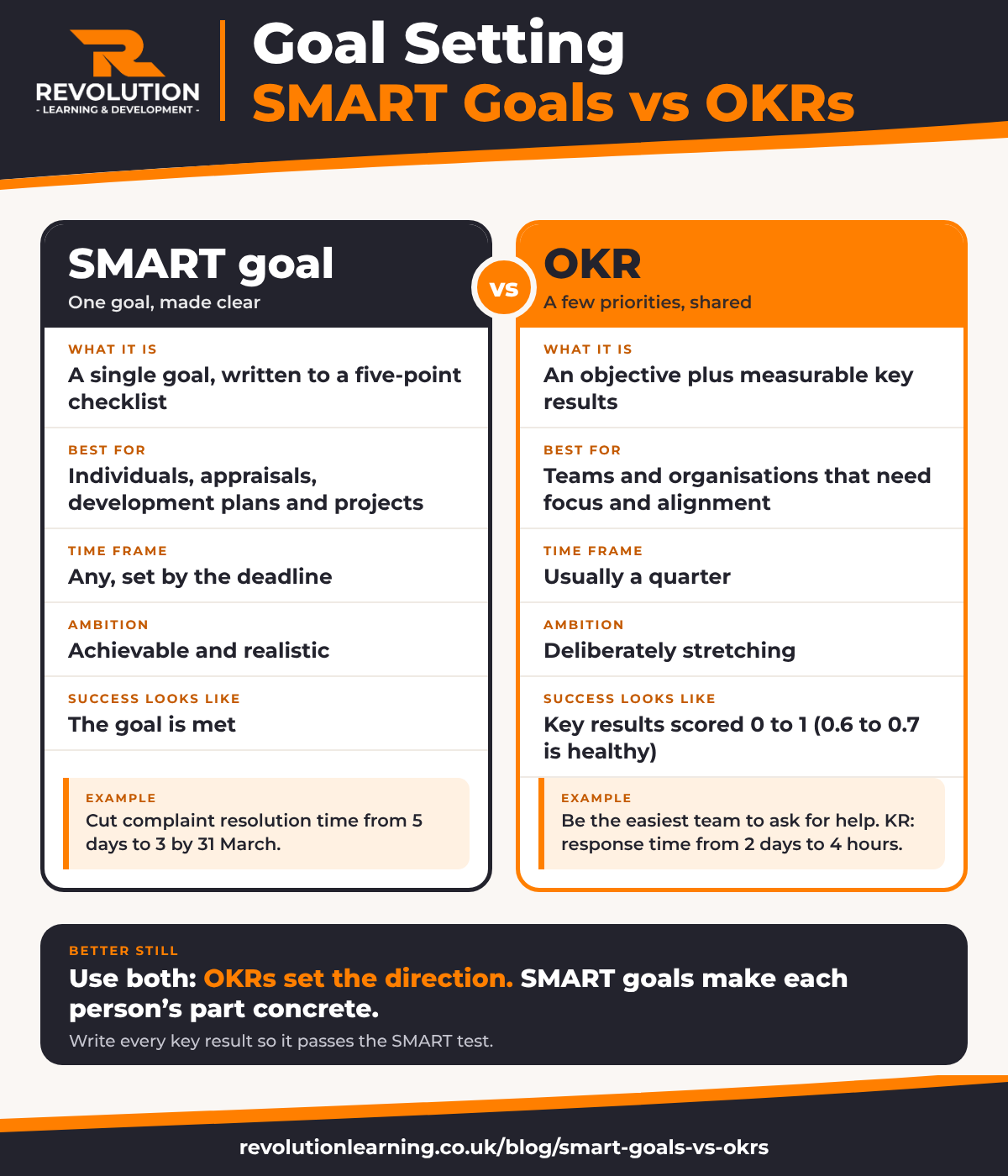
SMART goals and OKRs are two different tools for two different jobs. A SMART goal is a single, well-written target you can check off. OKRs (Objectives and Key Results) are a system for agreeing a few priorities across a team or organisation, usually for a quarter, and tracking progress towards them.
If you need to be clear about one thing you want to achieve, use a SMART goal. If you want a whole team pulling the same way on a handful of ambitious priorities, use OKRs. Many teams use both, and this post explains how.
The short answer
- SMART goals make one goal clear and checkable. They suit individuals, development plans, projects and performance reviews.
- OKRs focus a team or organisation on a few ambitious priorities and show how everyone’s work connects. They suit teams and companies.
- Using both works well. OKRs set the direction, and SMART goals turn each person’s contribution into something concrete.
What are SMART goals?
SMART is an acronym for a checklist that makes a goal clear enough to act on. The most common version is:
- Specific: exactly what you will do or achieve
- Measurable: how you will know you have done it
- Achievable: challenging, but possible with your time and resources
- Relevant: it matters to the bigger picture, such as your role, team or organisation
- Time-bound: it has a deadline
Example: “Reduce the average time to resolve customer complaints from five working days to three by 31 March, by introducing a daily triage meeting.” Compare that with “improve complaint handling”, which nobody can fail at or succeed at.
The SMART acronym was first set out by George T. Doran in the November 1981 issue of Management Review. His original wording was slightly different (Specific, Measurable, Assignable, Realistic and Time-related), and the letters still vary depending on who is using them. The “A” is often Attainable or Agreed, and the “R” is sometimes Realistic. Doran also pointed out that not every objective can be quantified at every level of management, so treat SMART as a writing aid rather than a rulebook.
What are OKRs?
OKR stands for Objectives and Key Results. An objective says where you want to get to. Key results are the measurable outcomes that show whether you are getting there.
- Objective: a short, memorable statement of what you want to achieve. It is qualitative and should be a little bit inspiring.
- Key results: usually two to five measurable outcomes for each objective. They are numbers, not tasks.
Example:
- Objective: Become the easiest team in the company to ask for help.
- Key result 1: Cut the average response time to internal requests from two days to four hours.
- Key result 2: Reach 90 per cent satisfaction on the post-request survey, up from 78 per cent.
- Key result 3: Resolve 80 per cent of requests at the first contact, up from 55 per cent.
OKRs are normally set quarterly, shared openly so people can see how their work connects, and reviewed regularly. Andy Grove developed them at Intel in the 1970s, building on Peter Drucker’s management by objectives. John Doerr, who learned the method at Intel, introduced them to Google in 1999 and later wrote them up in Measure What Matters (2018).
Ambitious OKRs are meant to stretch. Google scores key results from 0 to 1.0, and around 0.6 to 0.7 is treated as a healthy result for a stretch goal. If you hit 100 per cent every time, the targets were probably too easy.
SMART goals vs OKRs: the main differences
| SMART goal | OKR | |
|---|---|---|
| What it is | A single goal, written to a checklist | A framework: an objective plus measurable key results |
| Main job | Clarity on one thing to achieve | Focus and alignment across a team or organisation |
| Typical level | Individuals and projects (teams too) | Teams and organisations (individuals too) |
| Time frame | Any, set by the deadline | Usually a quarter, with a longer direction behind it |
| Ambition | Achievable and realistic | Often deliberately stretching |
| Success looks like | The goal is met | Progress against key results, often scored from 0 to 1 |
| Visibility | Often private, such as a review or development plan | Usually shared across the team or company |
| How many | As many as you can sensibly manage | A few, typically three to five objectives |
| Watch out for | Ticking the boxes without real ambition | Turning key results into a to-do list |
| Origin | George T. Doran, 1981 | Andy Grove at Intel in the 1970s, popularised by John Doerr |
Which should you use?
Neither is better. They answer different questions, so start with the question.
- Use SMART goals when you need a clear, individual target: a development goal, a performance objective, a project deliverable or a personal aim. They are simple, need no software and need no explanation.
- Use OKRs when a team or organisation needs to focus on a few big priorities, see how everyone’s work connects, and stretch beyond what feels comfortable.
- Use both when you want clear individual goals that line up with shared priorities. Write each key result so it passes the SMART test, and write the individual goals underneath as SMART goals.
- Use neither, yet, if you are not sure what matters. No framework fixes unclear priorities. It just records them in a tidier format.
If you are new to all this, start with SMART goals. If you want to try OKRs, pilot them with one team for one quarter before rolling them out. OKRs need a short weekly check-in and a proper review at the end of each quarter. If you cannot commit to that, SMART goals will serve you better.
Can you use SMART goals and OKRs together?
Yes, and it works well. OKRs answer “where are we heading this quarter?” SMART goals answer “what exactly will I do, and by when?”
Team key result: Reduce the average complaint resolution time from five working days to three by 31 March.
Individual SMART goal: Run the daily complaints triage meeting and respond to every new complaint within 24 hours, starting on 5 January.
The key result sets the destination. The SMART goal tells one person what to do on Monday morning.
Common mistakes with both
- Treating key results as tasks. “Launch the new website” is an activity. “Increase website enquiries by 25 per cent” is a result.
- Setting too many. Ten objectives is a wish list. Google’s guidance for teams is around three to five objectives, each with about three key results.
- Playing it safe. If every goal is hit every time, the goals were not stretching anyone.
- Treating “achievable” as “easy”. Research on goal setting generally finds that specific, challenging goals motivate better than easy ones. A 2021 review of SMART goals in physical activity research made a similar criticism of “achievable” and “realistic”. Aim for a stretch, not a stroll.
- Writing it once and filing it. Goals need regular check-ins. Weekly is ideal for OKRs, and monthly is a sensible minimum for SMART goals.
- Tying OKRs directly to pay. If missing a stretch target costs someone their bonus, they will stop stretching. Most OKR practitioners recommend keeping the two separate.
Your questions, answered
What does SMART stand for?
Specific, Measurable, Achievable, Relevant and Time-bound. Doran’s original 1981 wording was Specific, Measurable, Assignable, Realistic and Time-related, and you will see other variations in use.
What does OKR stand for?
Objectives and Key Results.
Who invented SMART goals?
George T. Doran, in a short article in Management Review in November 1981. It built on Peter Drucker’s earlier idea of management by objectives.
Who invented OKRs?
Andy Grove developed them at Intel in the 1970s. John Doerr learned the method there, introduced it to Google in 1999, and made it famous with the book Measure What Matters.
Are OKRs better than SMART goals?
No. They do different jobs. SMART goals make a single goal clear. OKRs align a group around a few priorities. Many teams use both.
Can individuals use OKRs?
Yes. Some people use personal OKRs to juggle several priorities. For a single development or personal goal, a SMART goal is usually all you need.
How many OKRs should a team have?
Around three to five objectives, with roughly three key results each, is the usual advice. More than that and priorities start to blur.
What is the difference between OKRs and KPIs?
KPIs (key performance indicators) track the ongoing health of something that should stay steady, such as customer satisfaction or monthly revenue. OKRs aim to change something over a set period. A key result is often a KPI with a target attached, such as “raise customer satisfaction from 82 to 90 per cent this quarter”.
How often should you review goals?
A 15-minute check-in each week works well for OKRs, with a proper review and scoring at the end of the quarter. For SMART goals, a monthly review is a good rhythm, with a conversation straight away if something goes off track.
What is a good OKR score?
For stretch (aspirational) OKRs, around 0.6 to 0.7 on a scale of 0 to 1 is generally seen as healthy. Committed OKRs, the ones you must deliver, should reach 1.0.
Want to put this into practice?
We have put the lot into a free guide: how to write SMART goals and OKRs, how to choose between them, and printable worksheets including a SMART goal sheet, an OKR planner, a weekly check-in and a quarterly review.
Just pop your details into the form below and we'll send you the PDF.We will only use your details to send the guide and a few useful follow-ups. Unsubscribe whenever you like. See our privacy policy.