
The Eisenhower matrix still works as a way to sort your work, but it asks the wrong questions for how most of us work now. “Urgent” used to mean a phone call or a memo. Today it can mean any message with a red dot next to it. The fix is not to bin the matrix. It is to upgrade the questions you ask of it, and to manage your attention as well as your time.
This post sets out four practical upgrades to the matrix, the attention research behind them, and what to do when the real problem is other people’s last-minute requests.
The short answer
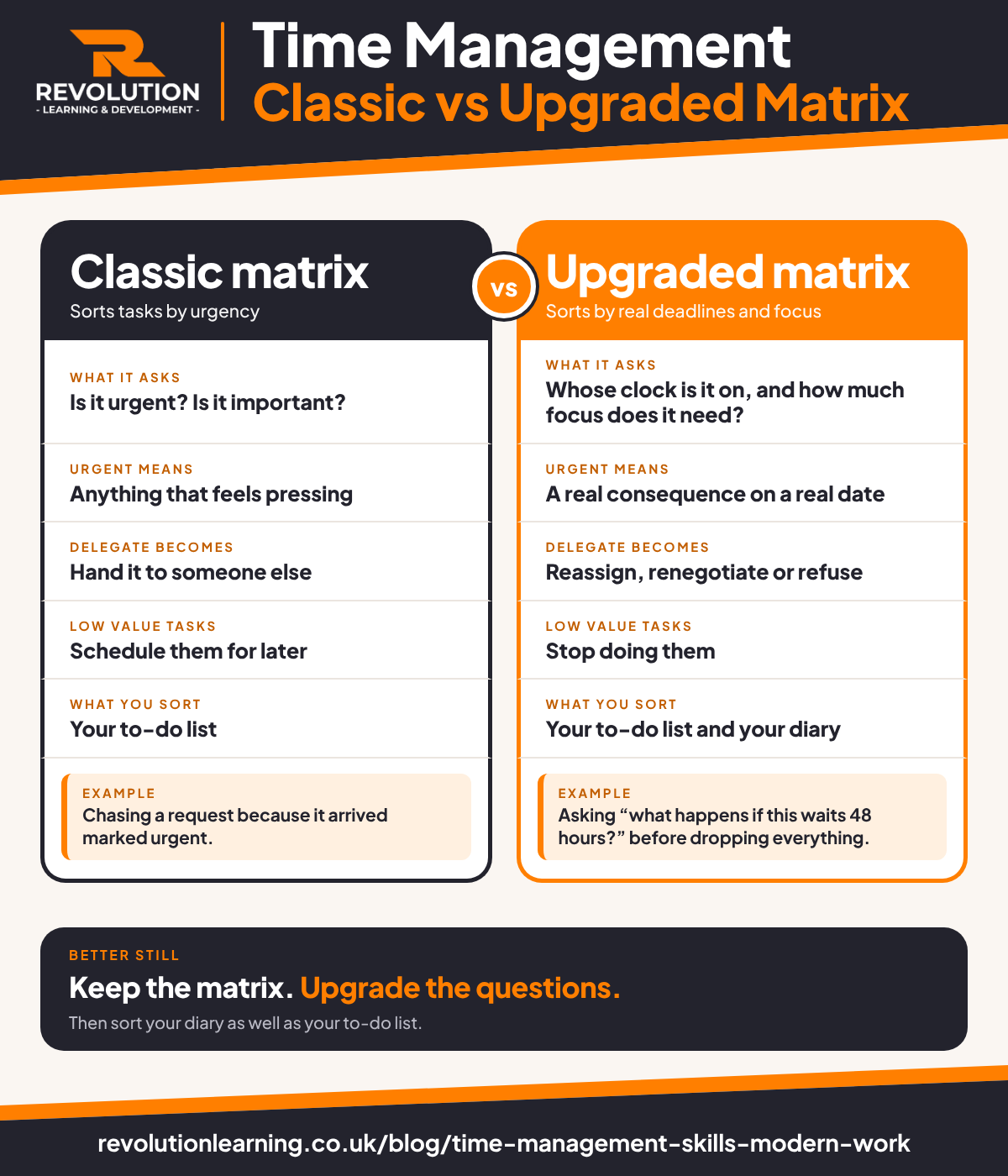
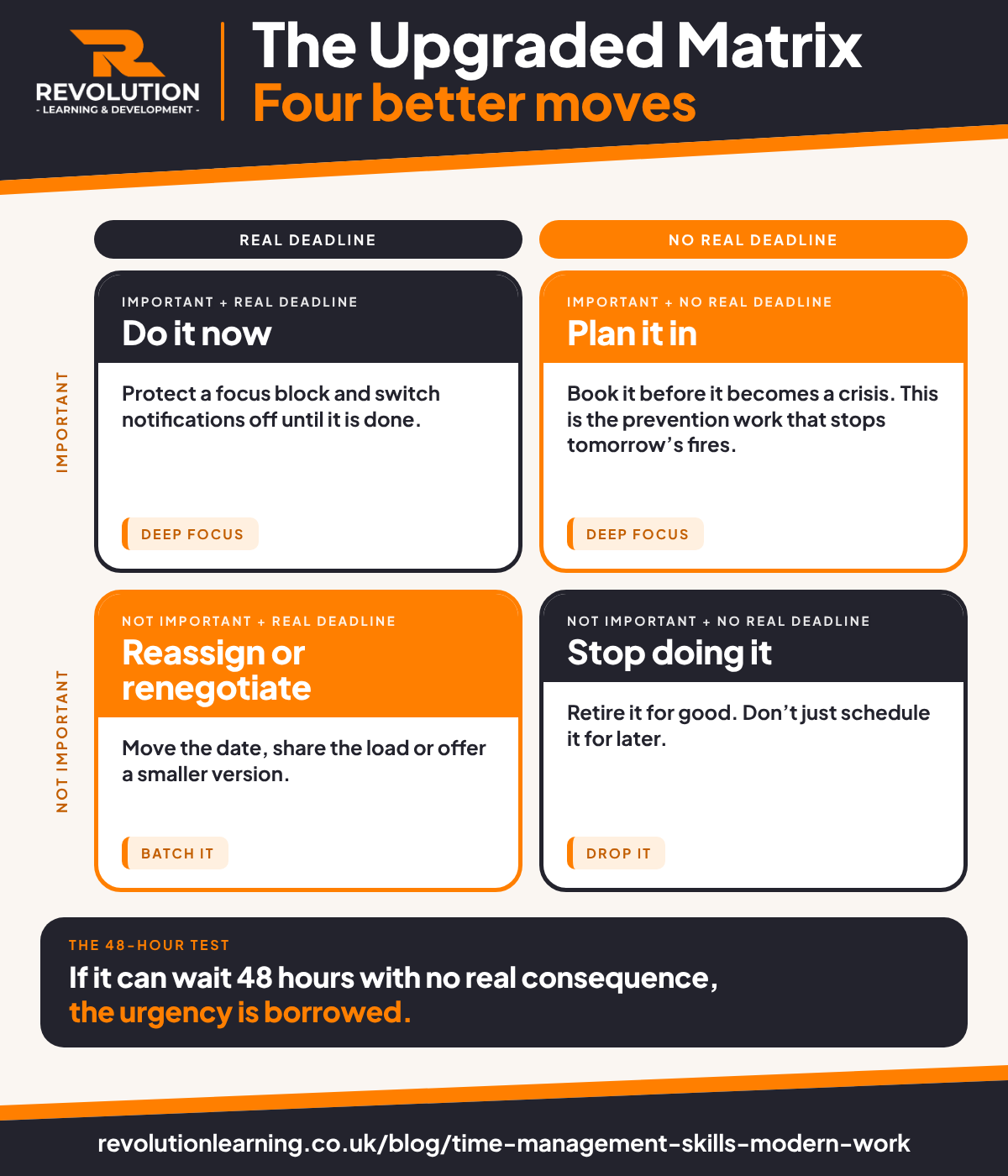
- Replace “urgent” with “whose clock is this on?” Real urgency has a real consequence on a real date. Borrowed urgency is someone else’s deadline landing on your desk.
- Add a third question: how much focus does it need? Deep work goes in protected blocks. Shallow work gets batched into gaps.
- Turn “delegate” into reassign, renegotiate or refuse. Plenty of people have nobody to hand work to, but nearly everyone can move a date or swap a priority.
- Make the bottom quadrant a stop-doing list. Retire low value work instead of scheduling it for later.
- Fix the system as well as yourself. Unclear briefs, late inputs and full diaries cost more time than personal habits do.
What is the Eisenhower matrix?
The Eisenhower matrix is a two-by-two grid that sorts tasks by whether they are urgent and whether they are important. Do the urgent and important tasks now, schedule the important but not urgent ones, delegate the urgent but not important ones, and drop the rest. It is named after Dwight D. Eisenhower, who spoke about urgent and important problems in a 1954 speech, and it was popularised by Stephen Covey in The 7 Habits of Highly Effective People (1989).
It has lasted because it forces a choice between what matters and what merely shouts. The trouble is the word “urgent”. Notifications, chat threads and “quick questions” all arrive looking urgent, and the classic matrix has no way of telling the real thing from the imitation.
Upgrade 1: Replace "urgent" with "whose clock is this on?"
Real urgency has a consequence and a date: a board paper due on Friday, a safety issue, a customer go-live, a legal deadline. Borrowed urgency is someone else’s lateness or panic, passed on to you with an exclamation mark.
The test is one question: what actually happens if this waits 48 hours? If the honest answer is “nothing much, somebody gets a bit impatient”, the urgency is borrowed.
That does not mean ignoring it. It means responding on your terms, usually with a short reply that says when you will do it. You stay helpful, and you stop letting other people’s planning set your day.
Upgrade 2: Add a third question, how much focus does it need?
Two equally important tasks can need very different kinds of time. Writing a proposal, analysing figures or planning a project needs a stretch of uninterrupted attention. Approving a document, replying to a query or booking a meeting can be done in a gap between other things.
Label every task deep or shallow. Put the deep ones in protected blocks in your diary, ideally at the time of day when you think best. Batch the shallow ones into set windows, so they stop slicing up everything else. This matters because of what happens to attention when you switch tasks (more on that below).
Upgrade 3: Turn "delegate" into reassign, renegotiate or refuse
The classic matrix says to delegate urgent but unimportant tasks. Many people have nobody to delegate to, so the advice goes nowhere. These three moves work for almost anyone:
- Reassign: “This would sit better with Priya, because she owns that process. Shall I point it her way?”
- Renegotiate: “I can do this by Thursday if the other piece moves to next week. Which would you prefer?”
- Refuse: “I can’t take this on without dropping something else. Can we ask our manager to decide which matters more?”
Each one makes the trade-off visible, which is usually all it takes. Most people know they should push back. The hard part is finding the words in the moment, so it helps to have two or three ready.
Upgrade 4: Make the bottom quadrant a stop-doing list
The classic matrix says to eliminate tasks that are neither urgent nor important. In practice most of us schedule them instead. Once a month, ask: what would I stop doing if nobody objected?
Look for recurring reports that nobody reads, meetings where you have no role, and checks that duplicate someone else’s. Stop one for a single cycle and see who notices. If nobody does, it is gone for good.
Sort your diary, not just your to-do list
For most office workers the biggest block of time is not the task list. It is the diary. Try this 10-minute exercise:
- Open last week’s diary.
- Sort every meeting and recurring commitment into the four quadrants of the upgraded matrix.
- Look at how much landed in “not important”.
- For each one, decide whether to decline, shorten it, send someone else, or replace it with a written update.
People are often surprised by how much of their week sits in the bottom half of the grid.
Manage your attention as well as your time
Professor Gloria Mark at the University of California, Irvine has spent two decades measuring how long people stay on one screen before switching. In 2004 it averaged about two and a half minutes. Her more recent figure is about 47 seconds. She has also found that after an interruption it takes around 25 minutes, on average, to get back to the project you were working on.
Part of the reason is what psychologist Sophie Leroy calls attention residue: when you switch tasks, part of your mind stays with the one you left, and your performance on the next one suffers. Mark also points out that many interruptions come from ourselves, not from other people.
Four habits help:
- Close the loop before you switch. Write two lines: where you are, and what happens next. It takes 30 seconds and makes it far easier to pick the work up again.
- Check messages at set times rather than continuously, especially during deep blocks.
- Notice the urge. Spotting the pull towards the phone or the inbox, and pausing for a few seconds, breaks the habit loop.
- Do fewer things at once. Cal Newport’s Slow Productivity (2024) argues for a smaller number of active projects, and Oliver Burkeman’s Four Thousand Weeks (2021) makes the case that you will never clear the list, so the real skill is choosing what to leave undone.
When the problem isn't you: fix the system
Personal time management can only do so much if work arrives late, briefs are vague and the diary is full of meetings. If that sounds familiar, the biggest gains come from team agreements, not personal willpower. Worth trying:
- A minimum brief. Five fields: who it is for, what they should think or do, the key message, the deadline and who signs it off. It takes a few minutes to complete and prevents hours of rework.
- Lead times by type of request, with a clearly defined fast lane for genuine emergencies, so not everything is treated as one.
- Limits on review. One decision-maker per piece of work, a maximum of two review rounds and a sign-off deadline.
- Protected focus time, such as meeting-free blocks. One MIT Sloan Management Review survey of 76 companies linked meeting-free days with higher reported productivity, autonomy and engagement, and lower stress. It is based on company surveys, not controlled trials, so treat it as encouraging rather than proven, and try it as an experiment.
- A rework log. For one month, note each late, unclear or redone request and the hours it cost. Numbers persuade people in a way that complaints rarely do.
Make it stick with if-then plans
Knowing what to do is not the same as doing it at 4pm on a busy Thursday. Psychologist Peter Gollwitzer’s research on implementation intentions shows that planning in an “if X happens, then I will do Y” format makes people more likely to follow through. A 2006 meta-analysis of 94 studies found a medium to large effect on goal achievement.
A few examples to adapt:
- “If a message arrives marked urgent, then I will ask what happens if it waits 48 hours before I reply.”
- “If I finish a deep work block, then I will check my messages once and plan the next block.”
- “If someone asks for work with no brief, then I will ask three questions: who is it for, what should they do, and who signs it off?”
One honest note: a 2026 systematic review from University College Cork looked at workplace time management interventions and rated the quality of the studies as low. In other words, nobody has proven the perfect technique. So treat everything here as an experiment. Try one change for two weeks, keep what helps and drop what doesn’t.
Your questions, answered
What is the Eisenhower matrix?
A two-by-two grid for sorting tasks by urgency and importance: do now, schedule, delegate or drop. It is named after Dwight D. Eisenhower and was popularised by Stephen Covey.
Is the Eisenhower matrix still worth using?
Yes, as a starting point. It is simple and it forces a decision. It works much better once you replace “urgent” with “whose clock is this on?”, add a deep or shallow label, and use it on your diary as well as your task list.
What is the difference between urgent and important?
Important tasks contribute to your goals and responsibilities. Urgent tasks need attention soon. The two overlap less often than it feels like they do, and a lot of what arrives as urgent is really borrowed urgency, meaning somebody else’s deadline.
What is the best time management technique?
There is no single best one, and the research is still patchy. Match the technique to the problem. If you struggle to choose between tasks, use the matrix. If you are constantly interrupted, use protected focus blocks and batched messages. If you plan well but don’t follow through, use if-then plans.
How do I manage my time when other people keep adding urgent work?
Use the 48-hour test to separate real from borrowed urgency, then reassign, renegotiate or refuse. If it keeps happening, raise it at team level and agree lead times, a minimum brief and a limit on review rounds.
How long does it take to get back on track after an interruption?
In Gloria Mark’s research it took around 25 minutes, on average, to return to the original project after being interrupted. Writing a two-line note before you switch makes returning easier.
Should my team have meeting-free days?
It is worth trying as a time-limited experiment. The evidence so far comes from surveys of companies rather than controlled trials, so measure what changes for your team: focus time, rework and stress.
Want to go further?
If you are setting goals as well as managing time, our guide to SMART goals vs OKRs explains how to choose between them and how to use both.
Sources and further reading
- Gloria Mark, Attention Span (2023), and her interview with UC Irvine News
- Sophie Leroy, “Why is it so hard to do my work? The challenge of attention residue when switching between work tasks” (2009)
- Peter Gollwitzer and Paschal Sheeran, “Implementation intentions and goal achievement: a meta-analysis of effects and processes” (2006)
- Laker, Pereira, Budhwar and Malik, “The Surprising Impact of Meeting-Free Days”, MIT Sloan Management Review (2022)
- Young and colleagues, “Do time management interventions support wellbeing in the workplace? A systematic review”, University College Cork (2026)
- Cal Newport, Slow Productivity (2024), and Oliver Burkeman, Four Thousand Weeks (2021)